
One room is not comfortable
An indoor-unit, airflow, drainage or local-control problem may affect one space. Other zones still matter because the indoor unit is part of a connected system.
Service for existing multi-zone systems
Restore reliable heating and cooling across your VRF or VRV zones. Airplex provides repair, diagnostics and maintenance in NYC and Northern NJ, addressing the connected system behind room complaints and recurring controller faults.
The service decision
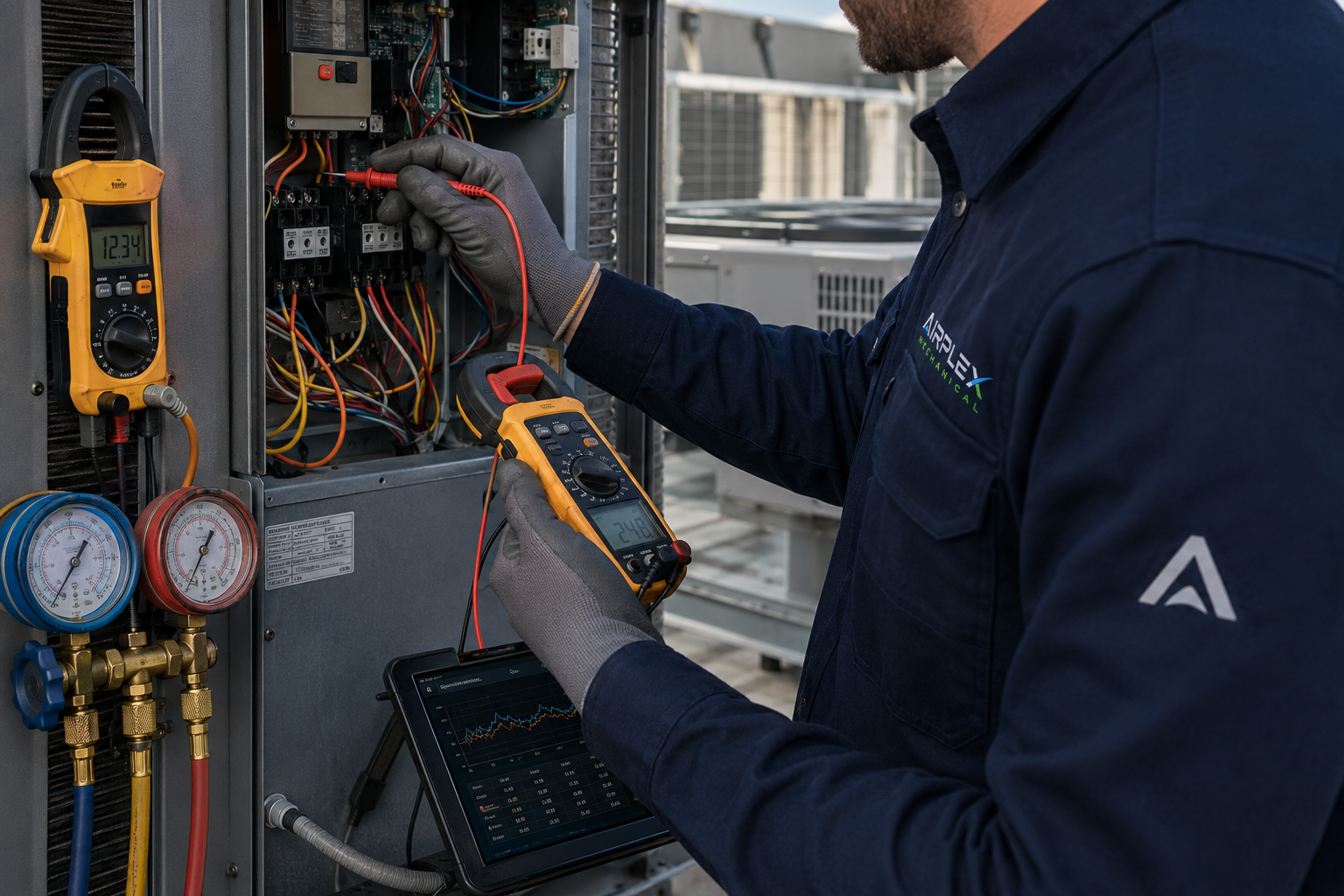
VRF and VRV systems connect indoor units, outdoor equipment and controls. A problem in one zone can be local, while several affected zones may share another cause. Airplex reviews the fault pattern and model-specific information before recommending repairs, helping you avoid treating an error code as a parts order.
Site coordination
In NYC and Northern NJ offices and managed buildings, indoor units may be spread across tenant spaces while outdoor units sit on restricted roofs. We help identify the access needed without requiring you to know the complete system before calling.
UNDERSTAND THE PROBLEM
The pattern across the zones helps focus the investigation.
An indoor-unit, airflow, drainage or local-control problem may affect one space. Other zones still matter because the indoor unit is part of a connected system.
We review the connected layout and fault information to investigate a shared interruption. An outdoor-unit, controls or communication concern can affect several rooms without each indoor unit having failed.
The exact code and previous repair findings help preserve the history. Clearing a message does not establish that the cause has been corrected.
YOUR SERVICE OPTIONS
An active fault needs diagnosis; planned care addresses the condition of the installed system.
Equipment combinations and control generations differ. Relevant manufacturer guidance and operating checks help determine the repair and any further investigation.
Maintenance can include appropriate filter, coil, drainage and operating checks. Access to all covered indoor units matters, not only the outdoor equipment.
A unit-level service history helps show whether a fault is new or part of a pattern. Keep repeat complaints visible when planning maintenance or deciding on replacement.
PLAN THE NEXT STEP
A change to connected equipment needs a compatibility review.
An isolated fault does not automatically require replacing every indoor unit. The diagnosis and supported repair determine the next step.
New outdoor equipment, indoor units and controls must work together. Confirm what can remain and what has to change before comparing installation prices.
New partitions or additional zones can change the system requirement. Treat that as a project review rather than assuming the existing system can accept an extra unit.
PRICING FACTORS
VRF repair cost depends on the fault, equipment family, parts and access to connected indoor and outdoor units. Maintenance, fault diagnosis and expansion are different scopes and should be compared separately.
VRF systems distribute refrigerant to multiple indoor units. That provides zone-level operation, but the indoor units are not necessarily independent systems. A local complaint can involve one unit, while a common fault can affect a group connected to shared equipment.
The service investigation should identify which units are affected and how they relate to the outdoor equipment and controls. A problem reported in one room does not automatically justify replacing the outdoor unit. Likewise, several simultaneous complaints should not be treated as unrelated indoor-unit failures without considering their shared arrangement.
Some VRF configurations operate their connected system in heating or cooling, while heat-recovery configurations can support simultaneous heating and cooling in different zones when designed to do so. The installed architecture determines the capability. A thermostat option alone does not establish that every combination of room demands is available.
This matters when occupants report that a room cannot operate in the mode they expect. The first question is whether the behavior is a fault or a limitation of the actual arrangement. Repair can restore intended operation, but it cannot turn one system architecture into another without a suitable redesign.
An indoor unit, outdoor section or controller must suit the connected system. Equipment generation and supported combinations matter, so a physically similar replacement is not automatically acceptable. The proposed scope should explain what is retained and what supports the selected combination.
When an exact replacement is unavailable, compare the supported alternatives and their effect on the rest of the system. A broader change may be necessary in some installations, but it should have a clear technical reason. This helps owners distinguish a genuine compatibility constraint from an unsupported recommendation to replace every component.
Routine care may involve individual indoor units and shared outdoor equipment, while diagnostics can require a view of the connected system. Keep unit identifiers and fault history together so repeated complaints can be related to the correct system. A list of room names without those relationships makes later service harder.
For recurring faults, the report should connect the observed symptom, the finding and the corrective work. If a connected control or proprietary function requires additional support, identify that responsibility. The useful result is a defined path to restoration, with the effect on other connected spaces understood before major work begins.
Questions before you request service
Not by itself. Codes are model-specific clues. Diagnosis must connect the message to the equipment and operating conditions before a part or repair is recommended.
Not necessarily. A repair may be limited to one component. If replacement is proposed, equipment compatibility and the condition of the connected system determine how much needs to change.
A local indoor-unit, control or distribution issue can affect one room while the shared system continues serving others. The room’s load or expected operating mode may also differ. Diagnosis should identify the local condition and its relationship to the shared system before selecting a replacement component.
Only if the selected equipment and system design support the proposed expansion. Connected capacity, controls, physical arrangement and model compatibility need review. An unused room or an apparently available connection does not establish that another unit can be added without wider changes.











Your next step
Tell us what is happening or what you want to change. You do not need to diagnose the system or assemble every equipment record before contacting Airplex.